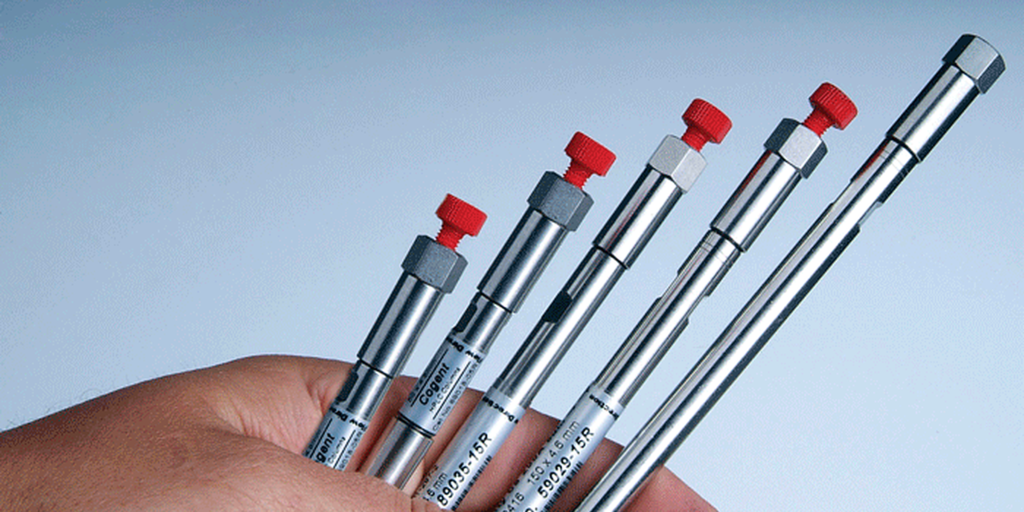
Developing a method for a new chiral separation is rarely straightforward. No single column works for every compound, and success depends on the compound’s structure, the sample matrix, the available instrumentation, and the goal of the separation.
Given that complexity, how can you narrow your options and form a working hypothesis before testing begins? A practical starting point is Daicel Chiral Technologies’ Application Center, which includes a searchable database of documented separations using Daicel columns. It doesn’t replace your own method development, but it can suggest starting conditions based on what has worked before. This article shows how to use the database to frame a first screen.
Define the goal of the chiral separation
Start by clarifying what your method must accomplish, such as separating enantiomers in a research sample or assessing a known impurity. A published separation of a related compound is a guide, not a substitute for work on your actual analyte and matrix: retention, enantioselectivity, and resolution can shift with mobile phase, temperature, sample solvent, column dimensions, and separation mode.
Use application data to frame a first screen
Once you’ve defined your goal, search the Daicel Chiral Application Database for comparable separations. You can search by structure, compound name, column, or API data; according to Daicel, it covers more than 2,200 compounds on CHIRALPAK®, CHIRALCEL®, and CROWNPAK® columns. Entries can show which columns and mobile phases have worked for a compound or related structure, helping you plan a first screen.
Choose a technique deliberately
Daicel describes three main techniques for chiral method development: high-performance liquid chromatography (HPLC) with organic solvent mixtures, HPLC with water-compatible mixtures, and supercritical fluid chromatography (SFC). Each can change how a compound interacts with the stationary phase, so decide early: conditions that give useful selectivity in an organic mobile phase may behave differently in a water-compatible system or in SFC. Keep the first screen purposeful and document your rationale for each condition.
Treat a database result as a hypothesis, not a conclusion
A database match tells you what worked for a similar compound, not what will work for yours. Daicel notes that its structure-based selection guidance rests on empirical observations and may not predict the separation of a particular compound. Be especially cautious with multiple chiral centres, impurities or isomers, or a complex sample matrix. Read each published application as a documented hypothesis (this column, this compound, these conditions) and judge whether your chemistry, instrumentation, and objective are comparable enough to justify a first experiment.
Questions to ask before you begin screening:
- What is your goal for the separation?
- What is your compound’s structure, and what similar compounds have documented separations?
- What is your sample matrix, and what detector will you use?
- Which technique fits your goal and equipment?
- What selectivity and resolution will count as success?
Source your supplies
Ready to screen? Our team at Canadian Life Science, a division of Calibre Lab, can help you source your columns and supplies. We receive Daicel columns weekly.
Not sure what you need? Our chiral screening service requires only 10-25 mg of your compound and its solubility information. Structure, similar compounds, and conditions you’ve already reviewed are helpful but optional. Your data is confidential and shared only with Daicel Chiral Technologies, under a non-disclosure agreement as needed.
Explore chiral separation resources with Canadian Life Science
Further technical resources
Newsletter module
Kicker: Chromatography & Lab Consumables
Headline: Start Chiral Method Development with a Better Question
Copy: Published chiral applications can help you frame an initial screening plan by structure, compound, column or operating mode. They are a starting point—not a substitute for laboratory verification.
CTA: Explore Chiral Technologies solutions with Canadian Life Science
Editorial validation checklist
- Confirm the final internal CLS destination for the CTA and whether the Daicel supplier page is ready for publication.
- Confirm that Chiral Technologies / Daicel product availability and support pathways cited by CLS are current for Canada.
- Review trademarks and first-use styling: CHIRALPAK®, CHIRALCEL® and CROWNPAK®.
- Confirm that any image selected for the hero or optional gallery has documented rights of use.
- Retain the source URLs and access date in the CMS editorial record; recheck claims if the source pages are updated before launch.