Pharmacopoeia regulations are a significantly important consideration for those in the pharmaceutical industry.
This is especially relevant when examining the monograph component of each respective pharmacopoeia.
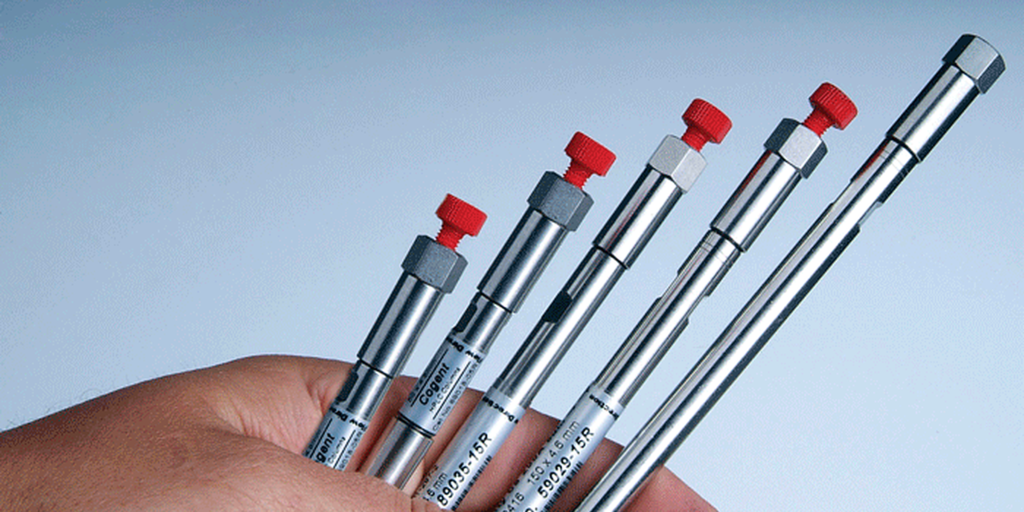
What approach should be taken when a monograph or method specifies a less common high-pressure liquid chromatography (HPLC) column geometry?
Let’s discover how a configuration table – and GL Sciences – can help.
The Column Geometry Challenge For Sourcing and Qualification
The pharmacopoeias with the highest global relevance are USP (United States Pharmacopoeia), EP (European Pharmacopoeia) and JP (Japanese Pharmacopoeia).
Their goal is to develop a consistent and uniform quality of starting materials and medicinal products, which is critical in achieving a safe, legally binding application for the patient.
HPLC columns are the main tool used for analytical separations. With respect to each pharmacopoeia’s monograph component, it specifies the corresponding methods upon which an active substance in a drug is analyzed.
These methods – often based on HPLC – describe the stationary and mobile phases, as well as the chromatographic conditions, like column temperature or injection volume.
Each pharmacopoeia also controls each method’s deviations, without the need to revalidate the entire method being used.
Each HPLC column geometry variance can have a profound effect on the efficiency, sensitivity, and speed of each application. For example, narrower columns increase sensitivity and reduce sample requirements, while wider columns accelerate analysis as well as minimize solvent consumption.
Selecting the incorrect HPLC column geometry for a specific analysis can lead to poor separation or low resolution, and possibly even total failure in detecting target analytes.
In some use cases of USP, EP, and JP, a method or monograph specifies the use of an HPLC column geometry that is not widely distributed. This presents a sizable challenge in terms of sourcing and qualification.
Leveraging a Configuration Table
The GL Sciences technical note LT131 details the CLS specialized product lineup in a handy configuration table, designed to fulfil the precise and stringent monograph requirements of USP, EP and JP.
LT131 focuses on less standard inner diameter and length dimensions (5 μm, 7 μm, 10 μm, and other ODS (C18) columns, specifically giving variations on the HPLC column bonded groups Octadecylsilane (C18/ODS) and Octylsilane (C8) (Note: LT131 does not include columns with standard dimensions, such as 5 μm, 150 x 4.6 mml.D., etc)
LT131 also offers multiple brand options depending on the desired inner diameter and length, and displays corresponding category numbers.
When any HPLC method calls for a less common geometry, start with the exact requirements needed, then use the table to verify the complete column configuration.
While notes like LT131 can help identify these specific configurations, there are other important factors at play.
Beyond Length and Diameter: Other Parameters to Consider
The range of HPLC columns is vast, as is the variety of selection criteria. In addition to internal diameter and length, other factors should be considered, including:
- Monograph
- Stationary phase chemistry
- Particle size
- Pore size
- Material compatibility with solvents and sample
- Instrument being used
- Laboratory quality procedures
Finding catalog specifications by leveraging technical notes – such as GL Sciences’ LT131 – provides value in terms of quick, standardized information retrieval, and how each specific dimension will perform in a vacuum.
However, this does not automatically mean that the configuration is suitable for a specific method. To demonstrate this, dynamic and logical verification and validation of the configuration is required, which then provides key, real-world performance data.
Verification Checklist
Before purchase, testing, or qualification, this handy verification checklist can help to obtain a successful outcome:
- Pharmacopoeia: Confirm the appropriate edition (USP, EP, or JP)
- Monograph: Confirm the drug’s quality expectations and validation tests
- Dimensions: Refer to configuration table to confirm proper length, diameter, etc
- Stationary Phase: Confirm the fixed material used
- Precolumn: Confirm whether any precolumn is being used, and if so, confirm the in-line filter’s frit porosity
- Instrument compatibility: Verify all HPLC instrumentation is compatible with all solvents, solutions and additives being used
- Internal Qualification Protocol: Verify that the HPLC system meets any pre-set functional or operational standards
Next Steps: How CLS Can Support
Choosing the correct HPLC column geometry is paramount for achieving high-quality, precise and efficient chromatographic analysis. This decision will profoundly influence resolution, speed, and system pressure.
When documenting overall performance, therefore, it is important to properly utilize configuration tables, identify all applicable parameters, and verify each aspect and step of the process.
Reach out for an informative and robust discussion on GL Sciences column options with CLS: