Reverse-phase high-performance liquid chromatography (HPLC) is the most widely-used separation mode across all analytical chromatography. Traditional reversed-phase columns are usually designed with hydrophobic stationary phases, providing excellent retention when it comes to non-polar and moderately polar compounds.
Let’s examine the specific circumstances under which a different approach to Hydrophilic Interaction Liquid Chromatography (HILIC) method development may be explored.
The Polar Analytes Challenge
In Reversed-Phase Chromatography (RPC), highly polar analytes are often challenging to retain for a number of reasons. These compounds may elute near the column dead volume, which can not only cause poor retention, but also result in reduced selectivity and limited resolution. It’s important to understand why this occurs, especially with respect to column selection and method development.
Many polar analytes share similar characteristics. They often have high water solubility, a strong hydrogen-bonding capability, significant ionic character, and a limited hydrophobic surface area. This means they also often show little attraction to a highly hydrophobic stationary phase. This ultimately results in limited retention control, which puts a major strain on both quantitative and qualitative analysis.
Therefore, alternative chromatographic approaches must be considered, in order to address retention and selectivity requirements for particularly challenging analytes.
The MicroSolv Cogent™ TYPE-C Difference
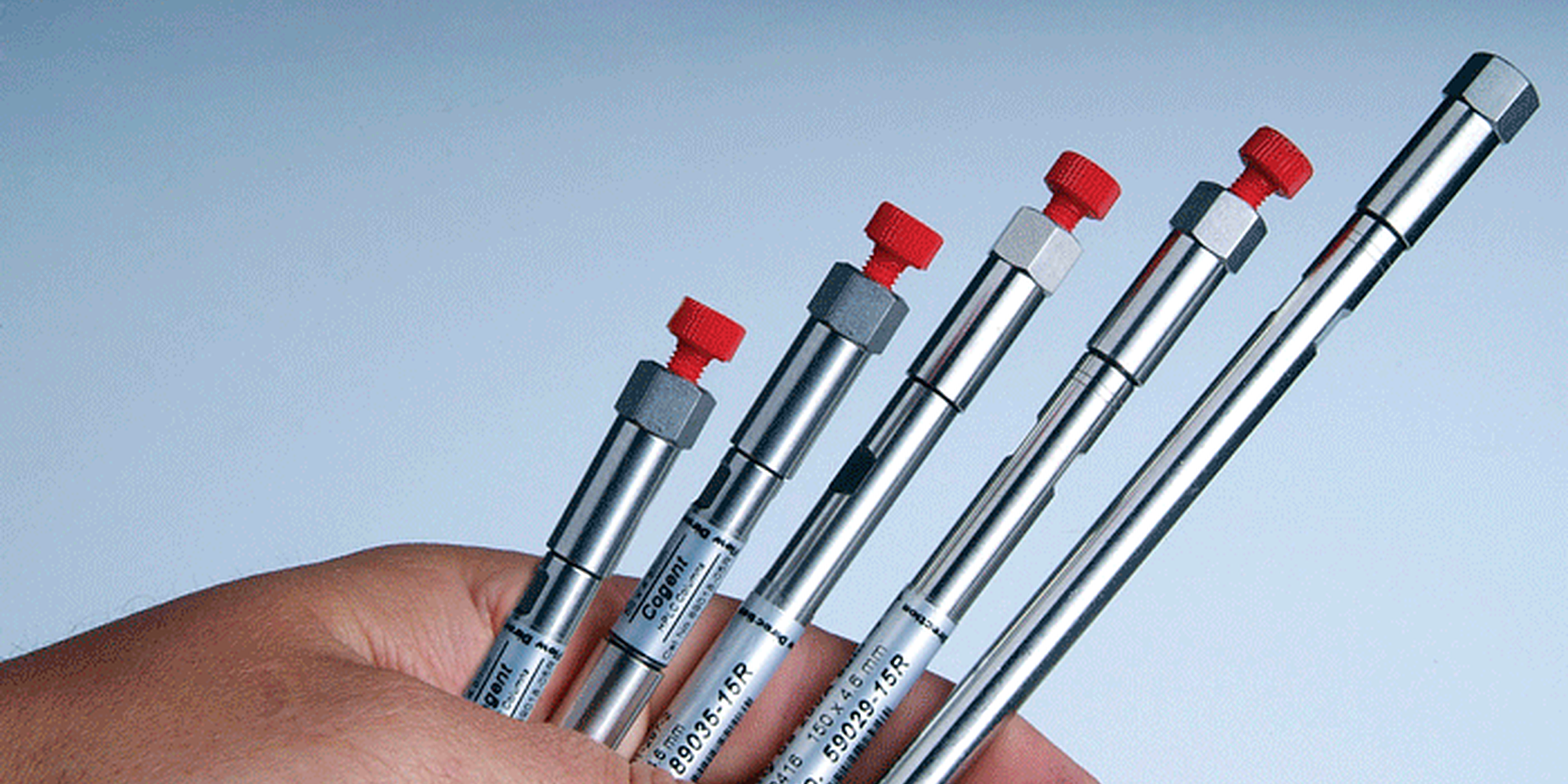
MicroSolv’s Cogent™ TYPE-C columns can be leveraged for HILIC separations of polar compounds.
Rather than more traditional silica-hydroxyl surfaces, Cogent™ TYPE-C columns utilize silica-hydride technology, which exhibits a surface that differs from conventional hydrophilic HILIC phases, pairing the platform with acetonitrile-rich conditions that are compatible with liquid chromatography–mass spectrometry (LC-MS).
The resulting surface chemistry enables retention mechanisms that can support the analysis of highly polar, moderately polar, and hydrophobic compounds, as well as complex mixtures that contain a broad polarity range.
Another Cogent™ TYPE-C differentiator from conventional reversed-phase systems is in its flexibility. Since the same column can often be used in both HILIC and RPC-like operating conditions, method development can be simplified, while also expanding chromatographic selectivity options.
HILIC Column Families To Consider
Traditional end-capped reversed-phase columns are often preferred for hydrophobic compounds, neutral analytes, and more routine reversed-phase methods. An HILIC scenario comes into consideration when dealing with highly polar analytes, water-soluble compounds, and challenging retention problems.
MicroSolv Cogent™ TYPE-C Silica columns may be a fit when samples contain both polar and non-polar compounds, when additional selectivity or retention flexibility is desired, or when HILIC and RPC-like separations may both be useful.
Four Cogent™ TYPE-C Silica columns in particular – Diamond Hydride™, Phenyl Hydride™, Amide™, and Silica-C™ – provide HILIC capabilities:
- Diamond Hydride™ possesses a precisely tuned, minimal organic moiety carbon layer.
- Phenyl Hydride™ imparts moderate hydrophobicity and unique aromatic selectivity due to its bonded phenyl groups.
- Amide™ offers a specialized polar bonded phase with a low carbon load.
- Silica-C™ provides the most hydrophilic stationary phase in the column portfolio, featuring a basic 4% carbon load without additional functional ligands.
Verifications for LC-MS & HILIC Methods
With respect to an LC-MS method, there are several validation or verification considerations to be made before any testing or transfer is completed. Quality in eight areas – accuracy, precision, specificity, quantification limit, linearity, recovery, matrix effect, and stability – is critical to successful method development.
Similarly in HILIC methods, proper phase selection depends on the analyte, the matrix, and the method. It is recommended to review a silica-hydride approach, and then assess phase selectivity in the chosen method.
Explore Your Options with CLS
When highly polar analytes present a particular challenge for HILIC method development, consider MicroSolv Cogent™ TYPE-C technology as a potential route.
Explore Cogent™ TYPE-C options with CLS.